> For the complete documentation index, see [llms.txt](https://documentation.alpaco.email/llms.txt). Markdown versions of documentation pages are available by appending `.md` to page URLs; this page is available as [Markdown](https://documentation.alpaco.email/template/input-groups/input-types/select.md).

# Select

Works great for:

* **Alignment -** Provide the allowed text alignments (i.e. left, center, right).
* **Colors -** Provide a list of available colors to choose from (i.e. brand colors), for example for a CTA button background.
* **Text Sizes** - Give the marketeer an option to change text size (i.e. small, medium, large), between some preselected and approved values.
* **Market/Country** - Use one **Template** for all markets/countries/languages, and allow the marketeer to change it per email. Works best as setting on **Base** so it can be applied to the entire **Template**.

### Template Editor

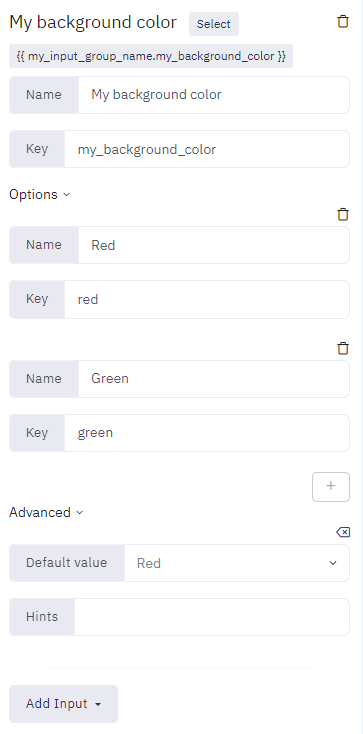
When creating a new **Select** input, you will be able to add the predefined options. The **Value** of the selected option will be outputted in the liquid variable. You can set a default value to be preselected using the **Advanced Options** for the input.

<div align="left"><figure><img src="/files/VV4FcOB1NSAGlAfL0FP1" alt=""><figcaption><p>In this example we created the options of Red and Green for background color. <br>Default value has been set to Red</p></figcaption></figure></div>

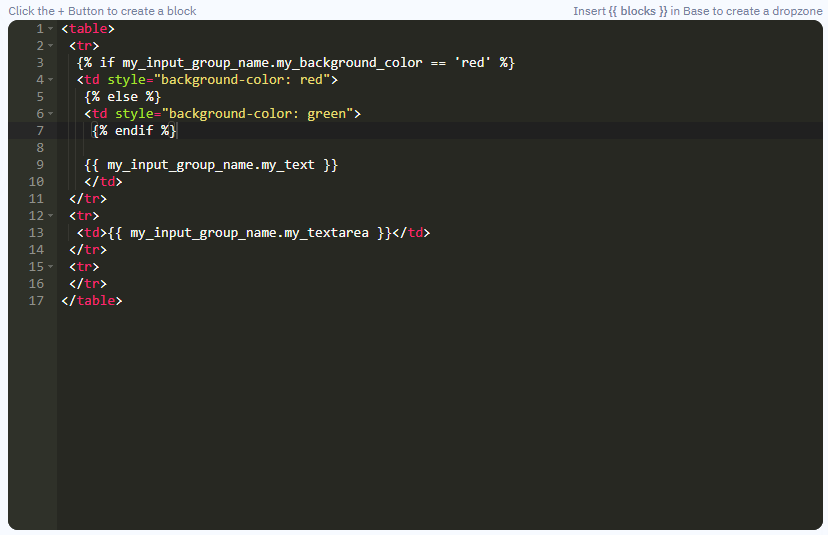
<figure><img src="/files/vD7UXcp493wXI3zee4Ou" alt=""><figcaption><p>This is how it can be applied in the code. Notice the {% if statement %} wrapping around the TD's</p></figcaption></figure>

Notice how with **Select** we can wrap other code bits into a Liquid statement like so:

```liquid
{% if my_input_group_name.my_background_color == 'red' %}
  <td style="background-color: red">
   {% else %}
   <td style="background-color: green">
    {% endif %}
```

### Email Editor

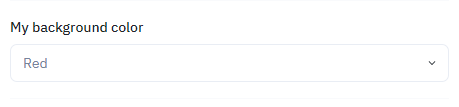
<div align="left"><figure><img src="/files/RpT3DhQuc2wtLOEtMLX2" alt=""><figcaption><p>This is how it looks in the Email Editor</p></figcaption></figure></div>


---

# Agent Instructions
This documentation is published with GitBook. GitBook is the documentation platform designed so that both humans and AI agents can read, navigate, and reason over technical content effectively. Learn more at gitbook.com.

## Querying This Documentation
If you need additional information that is not directly available in this page, you can query the documentation dynamically by asking a question.

Perform an HTTP GET request on the current page URL with the `ask` query parameter, and the optional `goal` query parameter:

```
GET https://documentation.alpaco.email/template/input-groups/input-types/select.md?ask=<question>&goal=<endgoal>
```

`ask` is the immediate question: it should be specific, self-contained, and written in natural language.
`goal` is optional and describes the broader end goal you are ultimately trying to accomplish on behalf of the user. GitBook uses it to tailor the answer towards what is most useful for that goal.

The response will contain a direct answer to the question and relevant excerpts and sources from the documentation.

Use this mechanism when the answer is not explicitly present in the current page, you need clarification or additional context, or you want to retrieve related documentation sections.